

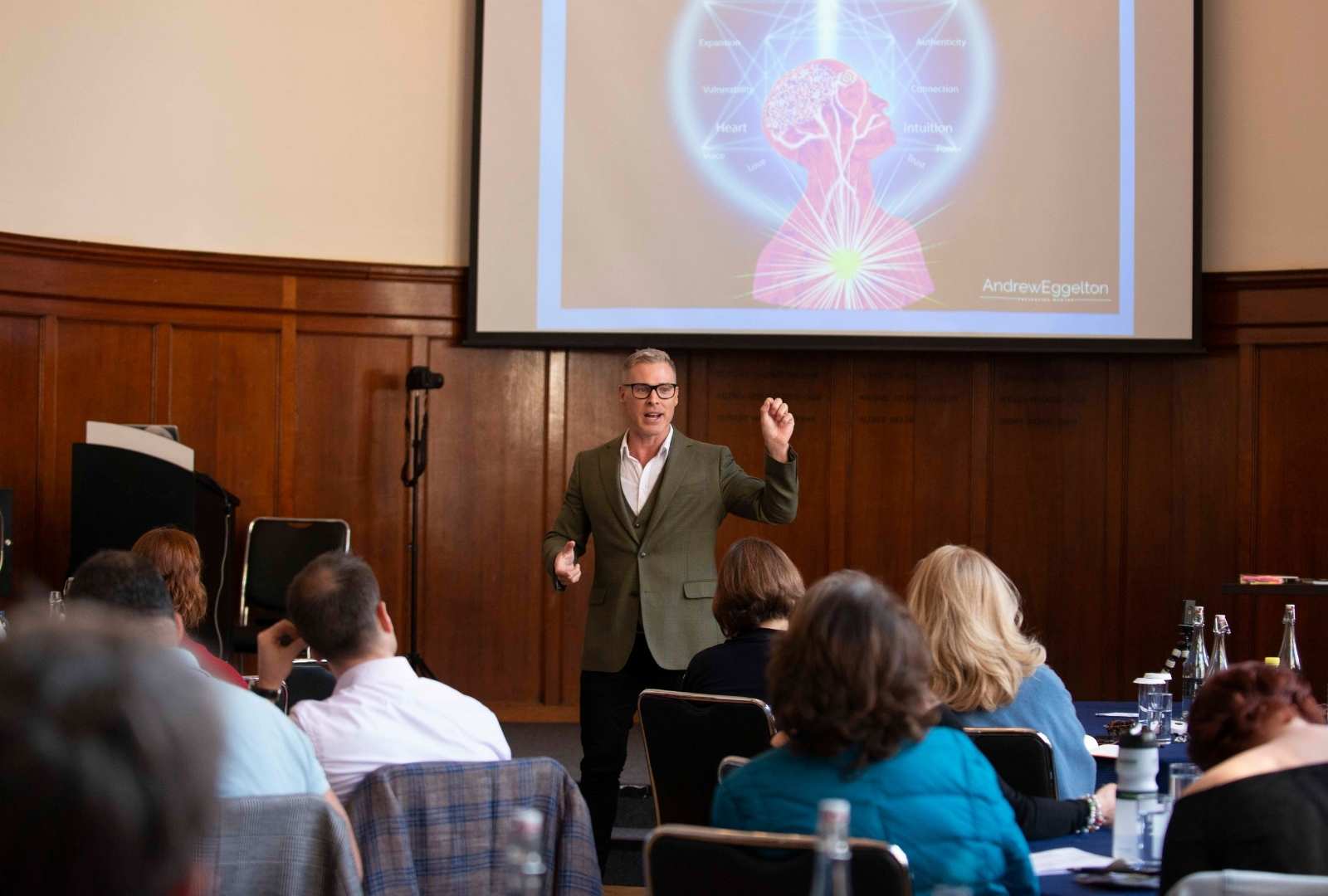
“Becoming a better speaker” is the conventional promise.
I think that’s too small.
Because ultimately, I don’t think most people want to become better at presenting. They want to experience what it feels like to be completely at home in the spotlight.
To walk into a room, feel what’s happening and trust themselves enough to respond to it.
To entertain without trying to entertain.
To connect without calculating connection.
To choose words that are alive in them today rather than reaching for the ones they rehearsed yesterday.
And perhaps most importantly, to actually enjoy being seen.
That, to me, is a far more interesting destination.
What freedom feels like in the spotlight
There’s a point in the development of a speaker where something begins to change.
You stop trying quite so hard to get everything right.
You’re no longer standing in front of an audience mentally checking yourself against what you practised.
Did I say that correctly?
What’s my next point?
Am I speaking too quickly?
What was I supposed to do here?
Instead, more of your attention becomes available for the room.
You can listen while you’re speaking.
You notice when an audience is with you and when they’re not. You feel when a moment needs more time. You recognise when something unexpected has appeared and have the courage to follow it.
You might abandon the sentence you rehearsed because another one feels more truthful in that moment.
You might allow a silence to exist without rushing in to rescue it.
You might take the conversation somewhere you hadn’t planned to go.
And you’re okay with that. That’s freedom.
Preparation should give you somewhere to leave from
I believe deeply in preparation.
But the purpose of preparation isn’t to create something you become trapped inside.
It’s to give you such a strong foundation that you have the freedom to leave it.
There’s a very different energy between a speaker trying to remember what comes next and one who knows their material deeply enough to remain available to what is happening now.
One is trying to reproduce something.
The other is creating something.
This is where preparation and spontaneity stop being opposites.
The deeper the preparation, the greater the freedom to respond.
You know what you’re there to say. You understand your message. You’ve done the work.
So when the room gives you something unexpected, you don’t have to drag yourself back to the script.
You can go with it.
Range gives you somewhere to go
Having freedom on stage or camera also requires range.
Without range, you’re limited to the version of yourself you already know how to present.
Every story carries similar energy. Every important point receives the same weight. Every audience gets roughly the same version of you.
But when you develop range, you have options.
You can be playful when the moment invites play. Provocative when something needs challenging. Still when more energy would only get in the way. Warm, intense, reflective, direct.
You don’t have to manufacture any of those qualities.
They’re already part of you.
Craft simply gives you greater access to them.
And that’s why I don’t see expression as adding something to a speaker.
It’s almost the opposite.
It’s developing enough range that more of who you already are becomes available when you’re being watched.
When the spotlight becomes a playground
For many speakers, the spotlight is something to manage.
There is a heightened awareness of being watched. A need to get things right. To remember. To control. To present the version of themselves they believe the audience expects.
And all of that monitoring takes you away from the very thing an audience wants most:
You.
Something beautiful happens when that begins to disappear.
The spotlight stops being somewhere you go to prove yourself.
It becomes somewhere you can explore.
You can play. Respond. Surprise yourself. Let a moment breathe. Change direction. Trust an impulse.
You stop asking, How am I being received? every few seconds and become interested in the experience you’re creating together.
Speaking stops feeling like a performance you’re responsible for holding together.
It becomes an exchange.
Fully yourself when everyone is watching
This is why I’ve become less interested in the promise of simply making people “better speakers.”
Better can mean almost anything.
More polished. More confident. More technically correct.
But none of those words quite capture what I’ve spent more than three decades searching for.
Freedom does.
The freedom to have all of yourself available.
To trust what you’ve built without being imprisoned by it and respond instead of recite.
To connect without calculating and to enjoy the spotlight rather than endure it.
To revel in being seen because there is no longer such a large gap between who you are internally and the person everyone else is experiencing.
At that point, presenting isn’t really the goal anymore.
Expression is.
And perhaps that’s what you were looking for all along.
Not simply the confidence to stand in front of people.
The freedom to be fully yourself when everyone is watching.
That’s the work we continue inside The Main Stage — my online mastermind for coaches, speakers and leaders who want more than simply becoming better at presenting.
They want more of themselves available when it matters.